The Gay Beam
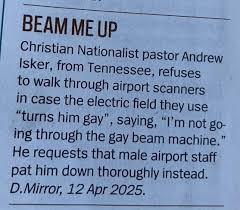
Pastor Andrew Isker opened his mouth on a podcast and accidentally performed the most comprehensive self-diagnosis since a medieval physician prescribed bloodletting for a broken leg, the patient died screaming, and the physician insisted the screaming meant it was working.
Isker started by questioning the constitutionality of the Patriot Act, which was a real "worst person you know just made a great point" moment, like watching a raccoon solve a Rubik's cube while the raccoon is simultaneously on fire. You want to be impressed. You can't be impressed. The raccoon is on fire and it's about to knock over your trash cans and shit everywhere and also it's on fire. And Isker, right on schedule, knocked over every trash can he could find while actively combusting.
"I had to be molested at the airport to go to Florida," Isker said, and already we're off the rails, already we're in the ditch, already the raccoon has the Rubik's cube in its mouth and is sprinting toward a fireworks factory, "just to get on an airplane, just because I'm not going to go through the gay beam machine."
The gay beam machine.
The gay beam.
Pastor Andrew Isker, Fourth Street Evangelical Church, graduate of a ministerial training school in Moscow, Idaho, which sounds like a Cold War joke but is actually a pipeline that produces Christian nationalists the way a puppy mill produces golden retrievers, except less house-trained and with significantly more opinions about women's bodies, co-author of a book literally titled Christian Nationalism with the CEO of Gab, which is the social media platform you join after every other social media platform has looked at your posts and changed the locks and hired security, host of a podcast called Contra Mundum that he calls "the number one Christian nationalist podcast in the world," a distinction that carries the same weight as "the loudest person at the Applebee's," this man, this pastor, this shepherd of souls, believes that a millimeter-wave imaging device purchased by the TSA from a defense contractor and installed in every major airport in America to detect concealed weapons also functions, as a secondary feature, like malware nobody installed, as a machine that converts your sexual orientation. You walk in straight. You walk out shopping for throw pillows with a man named Thomas and discussing whether the living room needs a second accent wall. The TSA has a lot of problems. The bins. The lines. The thing where they confiscate your toothpaste like it's enriched uranium. But nobody, until Isker, had identified their most ambitious covert program: Operation Turn Them Gay, powered by Raytheon, funded by your tax dollars, deployed at Gate B12, one heterosexual at a time, the most elaborate scheme to make men attracted to men ever conceived by the federal government, which is insane because it's the federal government, they can't get the website to work, they're trying to turn people gay through airport equipment.
So Isker chose the pat-down.
Isker chose to have a man, a male TSA agent, a stranger in a blue uniform and latex gloves, run his hands over Isker's body. His chest. His sides. His back. Down his legs. Around his waistband. The inner thigh, where the agent uses the back of his hand near the groin, because the front of the hand would be too intimate but the back of the hand, according to federal guidelines, is just government work, just professional touching, nothing weird about it, just a man's hands on your inner thigh in the name of national security. Isker chose all of that, the full body contact, the hands, the gloves, the "I'm going to use the back of my hand in sensitive areas, is that okay sir," and he chose it because he was afraid that standing still for four seconds in a glass booth might make him want to have sex with men. The hands of a man: safe. The light of a machine: gay. This is the theology. This is the doctrine. This is what they're teaching at the ministerial school in Moscow, Idaho, and if it isn't, it's what's graduating from it, and someone should check the curriculum the way you'd check a gas leak, urgently and with hazmat suits and professional ventilation.
But here's where it becomes a Hiaasen novel written by God during a manic episode. Here's where the plot turns in a way that no human screenwriter would attempt because no producer would greenlight it because every single producer would say "nobody is this stupid, this cannot be real, you've lost your mind." Isker didn't just choose the pat-down for himself. Isker made his co-host get the pat-down too.
C. Jay Engel. A grown man. Another adult human being with, presumably, his own testicles and his own opinions about who touches them and under what circumstances. Isker told Engel, on a podcast, "You're getting patted down too, buddy. I don't want them turning you gay." A pastor, an ordained minister, a man who has been granted spiritual authority over a congregation, physically intervened in the airport security process to ensure that another adult man did not walk through a machine, because the machine might alter that man's sexuality, might flip a switch somewhere in his brain like a light in a hallway, might change who he finds attractive, might do something permanent and irreversible to his sexual identity, might turn him into someone who likes men, and Isker, standing right there, was willing to prevent this by having another man touch his friend. Isker is managing another man's sexual orientation at the airport. Isker is standing at the TSA checkpoint operating as the sexual orientation supervisor for his co-host, like a lifeguard but for gayness, watching the water, making sure nobody drowns in the pink, keeping C. Jay Engel safe from the sapphic rays and the masculine waves. Isker looked at a grown man and said, effectively, "I know what's best for your body, you're not going through that thing, you're going to let this other man touch you instead, because that's the safe option, that's the godly option, that's the option where nobody turns gay," and Engel, who is also a grown man, said okay, and they both got patted down, by men, together, side by side, at an airport in Tennessee, two adults agreeing to be touched by a male TSA agent rather than stand in a scanner, and somewhere in the terminal a gate agent watched this happen and went home that night and told someone about it and that someone said "you're making that up" and the gate agent said "I am not making this up, I watched two grown men refuse a machine and choose to be groped by a federal employee because they think the machine is gay" and they sat in silence for a very long time.
Isker acknowledged the optics. Give him that. Give him credit for that moment of self-awareness that immediately vanished. "Having a guy touch you all over the place, on its face, seems worse," he said. He said those words. His mouth made those sounds. His brain assembled that sentence, held it up to the light like a diamond, inspected every facet, found it flawless, and shipped it to his vocal cords for public distribution on a podcast that bills itself as the number one Christian nationalist podcast in the world. "Having a guy touch you all over the place seems worse." Yes, Andrew. Yes it does. On its face. And on every other part of your face. And on every other part of your body that was just touched by a guy. Because you chose it. You chose the guy. You chose the hands. You chose the touching. You chose the intimacy. You chose, when presented with the two options of "stand still in a light for four seconds" or "have a man run his hands over your entire body," you chose the hands, and you made your friend choose the hands, and you did this to avoid being gay, and I need whoever is running this simulation to check the code because something is fundamentally broken and it's been broken for a while and it's not getting better.
Then Engel, the man who was just patted down by another man at the insistence of his pastor because a machine might have altered his sexuality, Engel's contribution was to speculate that the scanner might generate "virtual adrenochrome." Adrenochrome. The chemical compound that QAnon followers believe is harvested from the blood of murdered children by liberal elites to extend their own lives and maintain their youthful appearance and secret power structure and possibly also improve their golf swing. This is a thing grown adults, in the year of our Lord 2025, genuinely believe is real and is being stored somewhere in a warehouse and is being used for something important to the shadow government. And Engel thinks the TSA scanner might be producing a digital version of it. A virtual version. Of a chemical. That doesn't work the way he thinks it works. That cannot exist the way he believes it exists. From children who aren't there. In an airport. Through a device made by Raytheon. While you're holding your shoes and a Ziploc bag of three-ounce liquids and shuffling forward in socks on a floor that four hundred people have already shuffled across today and one of them probably had a contagious foot fungus and you're wondering if you have time for a Cinnabon before boarding and whether the Cinnabon is worth the guilt. The TSA agent running the scanner, a woman named probably Denise who makes $19.47 an hour and has been on her feet since 4 a.m. and is thinking about whether her kid's soccer practice got moved to Thursday or Friday and whether she remembered to pay the electric bill, Denise is apparently also operating a virtual child-blood-harvesting device between checking for belt buckles and telling people to remove their laptops and asking someone for the third time to take off their shoes, and Denise doesn't know this, and Denise's manager doesn't know this, and the head of the TSA doesn't know this, and Raytheon absolutely does not know this, and the CEO of Raytheon certainly does not know this, and nobody at Raytheon has ever thought about this for even a microsecond, and the only person on the entire planet who knows that the TSA scanner is producing virtual adrenochrome is C. Jay Engel, because Engel is on a podcast with a man who thinks the scanner turns you gay, and when you're already that far down the rabbit hole, when you've already built your entire theology on the foundation that a glass booth is a sexuality-altering beam and that the federal government is capable of this level of coordination and planning, virtual adrenochrome isn't even the weirdest thing you'll say before lunch, it's probably the third weirdest thing you'll say, right after something about how Denise's shoes are probably orthopedic because the government is controlling her spine through her footwear.
And here, right here, in this exact moment, in this exact terminal, is where the LGBTQ+ community delivered the punchline that God had been setting up since the moment Andrew Isker's parents decided to have unprotected sex. They looked at him. They looked at this large, bearded, thick-necked man in Tennessee who is absolutely, positively, undeniably terrified of a machine that might make men find him attractive, and they identified him, immediately, unanimously, with the instant and unerring precision of a community that has been identifying these men for decades, for centuries, for as long as there have been large bearded men trying to hide from things while simultaneously making themselves impossible to hide from, as a bear.
A bear.
For those blissfully unfamiliar: in gay culture, a bear is a large, hairy, typically bearded man. It is a category. It is a recognized type. It is a brand. It is a lifestyle. It is a thing that a specific and enthusiastic subset of the population finds so extremely attractive that they have built an entire infrastructure around finding, meeting, and celebrating it. Bears have their own subculture. Bears have their own events. Bears have their own magazines. Bears have their own dating apps. Bears have their own aesthetic. Bears have their own chat groups. Bears have their own resorts. And Andrew Isker, who will not walk through a machine at the airport because he's afraid it will make him appealing to men, is already appealing to men. Right now. As he is. Without the beam. Without the machine. Without any technology whatsoever. Without any modification or alteration or interference from Raytheon or the federal government or any external force whatsoever. Without anything except the very specific physical characteristics he was born with and has maintained through a lifetime of choices. Andrew Isker, standing in the TSA line in Knoxville, refusing the scanner, demanding the pat-down, is generating more homosexual interest per square foot than the machine he's afraid of could produce in a thousand years of continuous operation at maximum intensity. The machine is a millimeter-wave scanner manufactured by a defense contractor. Andrew Isker is a walking, talking, fully operational gay beam made entirely of genetics and beard hair, and he doesn't know it. He's the beam. He's been the beam this whole time. He walked into the airport afraid of the machine and he IS the machine. He is the exact thing the machine was supposed to create, except he arrived pre-loaded, factory-configured, ready to deploy. He's become the thing he was afraid of, except he's not afraid of the thing he became, he's just afraid of the machine, which is hilarious, which is the funniest thing that has ever happened in the history of human airports, which is cosmic comedy at the level of God saying to the universe during a particularly inspired moment, "Watch this, I'm going to make a man so afraid of being attractive to other men that he will voluntarily choose to be groped by a government employee at a security checkpoint to avoid it, and then I'm going to make him the exact physical type that gay men find most attractive, and then I'm going to let the internet find out, and it's going to be the funniest thing I've done since I put the platypus together, which was actually a bit of a joke too but nobody got it," and God did it, and it was good, and somewhere in heaven an angel is laughing so hard the clouds are actively shaking and rain is falling upward and a few seraphim have actually lost their wings from laughing so hard.
Isker doesn't know. Isker will never know. Isker will go through the rest of his life avoiding scanners, choosing pat-downs, policing his friend's bodies at airports, preaching about Trashworld, which is his word for modern civilization, he made it up, he capitalized it, he's very proud of it the way a toddler is proud of a word it invented for its own excrement, and Isker will never once look in a mirror long enough to see what the rest of the world has already seen, which is a man who looks like he was ordered from a catalog that Andrew Isker would burn if he knew it existed, a catalog that is probably on a shelf somewhere with little sticky tabs marking the pages, "this one," "definitely this one," "save this picture."
Isker moved to Tennessee to build a compound. Not a compound, a "community." A community of "Heritage Americans," a phrase that means what you think it means and what you hope it doesn't mean and you're wrong, it means exactly that and possibly worse. The website has Norman Rockwell paintings on it. Norman Rockwell, the painter of the American wholesome, the painter of small-town perfection, the painter of a version of America that never existed except in paintings, except in a fantasy, except in a lie. Norman Rockwell, whose paintings of small-town perfection Isker and his Heritage Americans use as the visual identity of the world they're trying to rebuild, the world they're trying to resurrect, the world they're trying to make real again even though it was never real in the first place. Norman Rockwell, who was investigated by his neighbors for being "too friendly" with the young men he used as models, a fact I'm going to leave right here on the ground like a rake for Isker to step on, because Norman Rockwell's America, the one on Isker's website, the one on Isker's book, the one in Isker's head when he closes his eyes and dreams of Heritage, was painted by a man who had some things he wasn't saying, and the painting was always a painting, not a documentary, not a historical record, not a blueprint for anything real, just a painting of a fantasy by a man with secrets.
Isker writes that modern women are afraid "a child might cut into brunch time." This man. This man who cannot navigate airport security without a sexual identity crisis. This man who polices his co-host's body at the checkpoint. This man who thinks Raytheon built a gay ray. This man who co-wrote a book with the CEO of a website that exists because the internet broke up with it and took out a restraining order. This man who trained at a school in Idaho run by a guy who thinks women should be silent and bear children and nothing else. This man who fled Minnesota because being disagreed with felt like persecution. This man who moved to Tennessee and was rejected by the Tennessee town at a town hall where a woman, a WOMAN, stood up and called him a wolf in sheep's clothing, which is the funniest thing anyone has ever said about Andrew Isker because wolves don't get pat-downs at the airport and wolves don't avoid body scanners and wolves don't worry about beams and wolves certainly don't make their friends get groped by strangers because they're worried a light might do something to their buddy's orientation, this man, this wolf in sheep's clothing who is afraid of a machine and chose the hands, has opinions about what women should do with their bodies. Has opinions about brunch. Has opinions about childbearing and duty and obedience and the sacred feminine role. Has opinions about what women owe to civilization. A man who cannot manage his own body through a security checkpoint without choosing to be fondled by a government employee has a theology about what women owe the world with theirs. The audacity isn't remarkable. Audacity is the factory setting on these men. What's remarkable is that God, in His infinite wisdom and His apparently infinite sense of humor, made Andrew Isker a bear, and put him in an airport, and let him choose the pat-down, and let the internet find out, and let all of us watch a man who thinks a machine can turn you gay walk directly, voluntarily, enthusiastically, into the hands of a man, and call it faith.
The scanner is still at the airport. It still works. It still doesn't turn anyone gay. It's been doing its job since installation, which is more than you can say for the pastor.
And somewhere in Gainesboro, Tennessee, Andrew Isker is writing a blog post about the decline of Western masculinity while convinced that the decline happened because men stopped being afraid of machines, and he won't walk through the scanner, and he won't look in the mirror long enough to see what the whole world has already seen, which is a man shaped exactly like the thing he's most afraid of becoming, a monument to his own irony, a living theological contradiction, standing in an airport, choosing hands over light, every single time, forever, world without end, amen, while the TSA agent Marcus goes home and forgets about him by the time he reaches his car.